Aside From Low Birthrates and High Death Rates, What Can Cause a Countrys Population to Decline?
A population decline (also sometimes called underpopulation, depopulation, or population collapse) in humans is a reduction in a homo population size. Over the long term, stretching from prehistory to the nowadays, Earth's total homo population has continued to grow; however, current projections suggest that this long-term trend of steady population growth may be coming to an end.[1]
Until the beginning of the Industrial Revolution, global population grew very slowly. Later near 1800, the growth rate accelerated to a elevation of 2.09% annually during the 1967-69 catamenia, but since then, due to the worldwide collapse of the full fertility rate, it has declined to 1.05% as of 2020.[2] The global growth rate in accented numbers accelerated to a summit of 92.ix million in 1988, but has declined to 81.three million in 2020.[three] Long-term projections signal that the growth rate of the human population of this planet will go along to turn down, and that by the terminate of the 21st century, it will attain nix.[2] Examples of this emerging tendency are Nihon, whose population is currently (2015–2020) failing at the charge per unit of 0.two% per year,[2] and Red china, whose population could start declining in 2027 or sooner.[four] By 2050, Europe'south population is projected to be declining at the charge per unit of 0.3% per twelvemonth.[two]
Population growth has declined mainly due to the abrupt turn down in the global full fertility rate, from 5.0 in 1960 to 2.3 in 2020.[5] The decline in the total fertility rate has occurred in every region of the world and is a result of a process known equally demographic transition. In order to maintain its population, ignoring migration, a country requires a minimum fertility rate of two.1[6] children per woman (the number is slightly greater than 2 because not all children live to machismo). Withal, almost all societies feel a drastic drop in fertility to well below 2 equally they grow more than wealthy (see income and fertility). The tendency of women in wealthier countries to take fewer children is attributed to a variety of reasons, such as lower infant mortality and a reduced need for children equally a source of family labor or retirement welfare, both of which reduce the incentive to take many children. Better access to instruction for young women, which broadens their chore prospects, is also often cited.[vii]
Possible consequences of long-term national population decline can be net positive or negative. If a state can increase its workforce productivity faster than its population is declining, the results, in terms of its economy, the quality of life of its citizens, and the environment, can exist cyberspace positive. If information technology cannot increase workforce productivity faster than its population'southward decline, the results can be negative.
National efforts to face up a failing population to engagement take been focused on the possible negative economic consequences and have been centered around increasing the size and productivity of the workforce.
Causes [edit]
A reduction over time in a region'due south population tin can be caused by sudden agin events such as outbursts of communicable diseases, famine, and war or by long-term trends, for example sub-replacement fertility, persistently low birth rates, high mortality rates, and continued emigration.
Curt term population shocks [edit]
Historical episodes of short-term human population decline have been common and have been caused by several factors.
- high expiry rates caused by disease, for example the Black Death that devastated Europe in the 14th and 17th centuries, the arrival of Old Earth diseases in the Americas during European colonization, and the Castilian influenza pandemic afterward Earth War I,
- famine, for example the Great Irish gaelic Famine of the 19th century, and the Nifty Chinese Famine caused past the Smashing Leap Forward which caused tens of millions of deaths
- war, for example, the Mongol invasion of Europe in the 13th century that may have reduced the population of Hungary by twenty–40%,
- civil unrest, for instance the forced migration of the population of Syrian arab republic because of the Syrian Civil State of war
Less frequently, short term population declines are caused by genocide or mass execution. For example, it has been estimated that the Armenian genocide acquired 1.v million deaths, the Jewish Holocaust virtually 6 million, and, in the 1970s, the population of Cambodia declined because of wide-scale executions by the Central khmer Rouge.
In modernistic times, the AIDS pandemic caused temporary declines in the population of some African countries,[ citation needed ] [ which? ] and the on-going COVID-xix pandemic has caused short-term drops in fertility[viii] and significant excess bloodshed in a number of countries.[9]
Some population declines outcome from indeterminate causes, for example, the Bronze Historic period Collapse, which has been described equally the worst disaster in ancient history.[10]
Long term historic trends in earth population growth [edit]
In spite of these short-term population shocks, world population has continued to grow. From effectually 10,000 BC to the beginning of the Early Modern Period (by and large 1500 – 1800), world population grew very slowly, effectually 0.04% per yr. During that period, population growth was governed by weather at present labeled the "Malthusian Trap".
After 1700, driven by increases in human productivity due to the Industrial Revolution, peculiarly the increase in agricultural productivity,[eleven] population growth accelerated to around 0.6% per year, a rate that was over 10 times the rate of population growth of the previous 12,000 years. This rapid increase in global population caused Malthus and others to enhance the offset concerns about overpopulation.
After Globe State of war I birth rates in the United States and many European countries cruel beneath replacement level. This prompted business organization nigh population decline.[12] The recovery of the birth charge per unit in nearly western countries around 1940 that produced the "baby boom", with annual growth rates in the 1.0 – 1.five% range, and which peaked in 1968 at 2.i% per year,[13] temporarily dispelled prior concerns about population decline, and the world was one time again fearful of overpopulation.
But after 1968 the global population growth rate started a long pass up, and in the period 2015–2020 it is estimated to be about i.ane%,[two] half of its elevation in 1968. Although nevertheless growing, global population is predicted to level out around the end of the 21st century,[14] and some sources predict the showtime of a refuse before and then.[12] [15] The chief cause of this phenomenon is the abrupt decline in the global full fertility charge per unit, from five.0 in 1960 to ii.3 in 2020.[5] The turn down in the full fertility rate has occurred in every region of the earth and has brought renewed concern from some for population refuse.[12]
The era of rapid global population increase, and concomitant concern almost a population explosion, has been curt compared with the span of human history. It began roughly at the commencement of the industrial revolution and appears to be now cartoon to a close in the Western earth.[12]
Possible consequences [edit]
Predictions of the net economic (and other) effects from a slow and continuous population decline (east.g. due to low fertility rates) are mainly theoretical since such a phenomenon is a relatively new and unprecedented 1. The results of many of these studies show that the estimated bear upon of population growth on economic growth is by and large small and can exist positive, negative, or nonexistent. A recent meta-written report found no relationship between population growth and economic growth.[16]
Possible positive furnishings [edit]
The furnishings of a failing population can be positive. The single best guess of economical success is the growth of GDP per person, not total Gross domestic product.[17] GDP per person (too known equally GDP per capita or per capita GDP) is a rough proxy for boilerplate living standards.[eighteen] A state can both increase its average living standard and grow total GDP even though its population growth is low or even negative. The economies of both Nihon and Germany went into recovery effectually the fourth dimension their populations began to decline (2003–2006). In other words, both the full and per capita GDP in both countries grew more quickly after 2005 than before. Russia's economy as well began to grow rapidly from 1999 onward, even though its population had been shrinking since 1992–93.[xix] Many Eastern European countries accept been experiencing like effects to Russia. Such renewed growth calls into question the conventional wisdom that economical growth requires population growth, or that economic growth is incommunicable during a population decline.
More recently (2009–2017) Nihon has experienced a college growth of GDP per capita than the United States, even though its population declined over that period.[17] In the United States, the relationship betwixt population growth and growth of Gdp per capita has been constitute to be empirically insignificant.[20] All of this is further proof that individual prosperity can grow during periods of population decline.
Attempting to ameliorate understand the economic affect of these pluses and minuses, Lee et al. analyzed data from 40 countries. They found that typically fertility well higher up replacement and population growth would exist almost beneficial for government budgets. Fertility near replacement and population stability, even so, would be about beneficial for standards of living when the assay includes the effects of age construction on families as well as governments. Fertility moderately below replacement and population decline would maximize per capita consumption when the cost of providing capital for a growing labor force is taken into account.[21]
A focus on productivity growth that leads to an increase in both per capita GDP and total GDP can bring other benefits to:
- the workforce through higher wages, benefits and meliorate working conditions
- customers through lower prices
- owners and shareholders through higher profits
- the surround through more than coin for investment in more stringent environmental protection
- governments through higher tax proceeds to fund government activities
Another approach to possible positive furnishings of population decline is to consider Earth's carrying chapters. The human carrying capacity of the World has been estimated to exist 500 million, 1 billion or upward to 12 billion. According to these studies, the human carrying capacity has already been exceeded or would be exceeded by the year 2100,[22] therefore a global population pass up would counteract the negative effects of human overpopulation.
Possible negative furnishings [edit]
The effects of a failing population can also be negative. Every bit a land's population declines, GDP growth may grow even more slowly or may even turn down. If the turn down in total population is not matched past an equal or greater increment in productivity (GDP/capita), and if that condition continues from one calendar quarter to the side by side, it follows that a country would feel a decline in Gdp, known every bit an economic recession. If these conditions become permanent, the country could find itself in a permanent recession.
Other possible negative impacts of a declining population are:
- A ascension in the dependency ratio which would increment the economical pressure on the workforce
- A crisis in finish of life care for the elderly because in that location are insufficient caregivers for them[23]
- Difficulties in funding entitlement programs because there are fewer workers relative to retirees[24]
- A pass up in war machine strength[12]
- A refuse in innovation since change comes from the young[24]
- A strain on mental wellness acquired by permanent recession[25]
- Deflation caused by the ageing population[26]
All these negative effects could be summarized under the heading of "Underpopulation". Underpopulation is ordinarily defined as a state in which a state'due south population has declined too much to support its current economic system.[27]
Population turn down can cause internal population pressures that so lead to secondary effects such as ethnic conflict, forced refugee flows, and hyper-nationalism.[28] This is especially true in regions where different indigenous or racial groups have unlike growth rates.[29] An example of this is white nationalism. White nationalists seek to ensure the survival of the white race, and the cultures of historically white nations. Many white nationalists believe that white people should therefore maintain a demographic majority[thirty] and that mass immigration of not-whites and depression nascence rates amid whites are threatening the white race.[31] Depression fertility rates that cause long-term population decline can also atomic number 82 to population ageing, an imbalance in the population age construction. Population ageing in Europe due to depression fertility rates has given rise to concerns about its impact on social cohesion.[32]
A smaller national population can also have geo-strategic furnishings, merely the correlation betwixt population and power is a tenuous 1. Technology and resources often play more pregnant roles. Since Globe War 2, the "static" theory saw a population'southward absolute size as beingness ane of the components of a country's national power.[33] More recently, the "human capital" theory has emerged. This view holds that the quality and skill level of a labor force and the technology and resources available to information technology are more than important than simply a nation's population size.[33] While in that location were in the by advantages to high fertility rates, that "demographic dividend" has now largely disappeared.[34]
Contemporary decline by country [edit]
The table below shows the countries that take been affected by population decline between 2010 and 2020. The term "population" used here is based on the de facto definition of population, which counts all residents regardless of legal status or citizenship, except for refugees not permanently settled in the country of asylum, who are by and large considered part of the population of the country of origin. This means that population growth in this table includes net changes from immigration and emigration. For a tabular array of natural population changes, see list of countries by natural increase.
| Country or region | Population estimate (one July 2020) | Boilerplate annual rate of population change (%) | Low nascency charge per unit | High death charge per unit | Emigration | Aging population | High rate of abortion | |
|---|---|---|---|---|---|---|---|---|
| 2010–2015[ii] | 2015–2020[2] | |||||||
 Andorra Andorra | 77,543 | −1.59 | −0.nineteen | Yes | Yes | Yes | ||
 Albania Albania | two,877,797 | −0.39 | −0.09 | Yes | Yes | Yes | ||
 Bosnia and Herzegovina Bosnia and Herzegovina | 3,276,845 | −ane.55 | −0.89 | Yep | Yes | Yep | ||
 Bulgaria Bulgaria | 6,520,314 | −0.62 | −0.71 | Yes | Yes | Yep | Yes | Aye |
 Croatia Croatia | 4,105,267 | −0.45 | −0.61 | Yes | Yes | Yeah | Aye | |
 Estonia Estonia | 1,326,804 | −0.25 | +0.17 | Yes | Yes | Yes | Yes | |
 Georgia[Annotation 1] Georgia[Annotation 1] | three,989,167 | −0.37 | −0.17 | Yes | Yes | Yes | Yep | |
 Greece Greece | x,423,054 | −0.42 | −0.45 | Yes | Yes | Yes | ||
 Republic of hungary Republic of hungary | 9,660,351 | −0.thirty | −0.24 | Yes | Aye | Yes | Yes | |
 Italy Italy | 60,461,826 | +0.42 | −0.04 | Yes | Yes | |||
 Japan Japan | 126,476,461 | −0.09 | −0.24 | Yes | Yes | |||
 Latvia Latvia | one,864,884 | −i.18 | −i.15 | Yes | Yes | Yes | Yes | |
 Lithuania Lithuania | 2,678,864 | −1.27 | −1.48 | Aye | Yes | Yeah | Yes | |
 Moldova[Note 2] Moldova[Note 2] | 4,033,963 | −0.07 | −0.xviii | Yep | Yes | Yes | Yeah | |
 Poland Poland | 37,846,611 | −0.xv | −0.x | Yeah | Yes | Aye | ||
 Portugal Portugal | 10,196,709 | −0.43 | −0.33 | Yes | Yeah | Yes | ||
 Puerto Rico[Note three] Puerto Rico[Note three] | 2,860,853 | −1.14 | −3.34 | Yes | Aye | Yes | ||
 Romania Romania | 19,237,691 | −0.54 | −0.seventy | Yeah | Yes | Aye | Yes | |
 Serbia Serbia | vi,740,936 | –0.17 | −0.33 | Yes | Yep | Yes | Yep | |
 Kingdom of spain Kingdom of spain | 46,745,896 | −0.11 | +0.04 | Yeah | Yes | |||
 Syrian arab republic[Notation iv] Syrian arab republic[Notation iv] | xviii,207,894 | −3.43 | −0.56 | Yes | Yes | |||
 Ukraine[Notation 5] Ukraine[Notation 5] | 41,390,728 | −0.38 | −0.54 | Yes | Yeah | Yes | Aye | Aye |
 Venezuela[Note half-dozen] Venezuela[Note half-dozen] | 28,609,886 | +1.12 | −1.12 | Yep | Yes | |||
- ^ Effigy includes Abkhazia and South Ossetia.
- ^ Includes the Pridnestrovian Moldavian Republic.
- ^ Aftermaths of Hurricane Maria acquired an extreme surge in the traditional migration flows to the U.S. mainland.
- ^ Syrian civil war that caused high civilian deaths and a massive refugee crisis.
- ^ Full general socio-economic collapse following the War in Donbas.
- ^ General socio-economic collapse caused by the ongoing political crisis.
Eastern asia [edit]
Japan [edit]
Though Japan's natural increment turned negative as early on as 2005,[35] the 2010 census issue effigy was slightly college, at just in a higher place 128 million,[36] than the 2005 census. Factors implicated in the puzzling figures were more Japanese returnees than expected as well every bit changes in the methodology of data collection. However, the official count put the population as of October ane, 2015, at 127.1 meg, downwards past 947,000 or 0.7% from the previous quinquennial census.[37] [38] The gender ratio is increasingly skewed; some 106 women per 100 men live in Japan. In 2019, Japan'due south population fell by a record-breaking 276,000; if clearing is excluded from the figures, the driblet would have been 487,000.[39] Given the population boom of the 1950s and 1960s, the total population is still 52% above 1950 levels.[40]
South Korea [edit]
South korea's total fertility charge per unit has been consistently lower than that of Japan, breaking beneath 1 in 2018, and vicious to 0.84 in 2020. Every bit a result, its population brutal in 2020 for the starting time fourth dimension in the state's history.[41]
Taiwan [edit]
Taiwan recorded more than deaths than births in first quarter of 2021, despite recording virtually no COVID-19 deaths,[42] likely to proceed equally long term demographic trend.
Eastern Europe and former Soviet republics [edit]
Population in the ex-USSR and Eastern Europe is rapidly shrinking due to low nascency rates, very loftier death rates (linked to alcoholism[43] and high rates of infectious diseases such every bit AIDS[44] and TB[45]), too as high emigration rates. In Russian federation and the old communist bloc, nascency rates roughshod abruptly later the fall of the Soviet Union, and expiry rates by and large rose sharply. In addition, in the 25 years after 1989, some xx million people from Eastern Europe are estimated to take migrated to Western Europe or the United states.[46]
Armenia [edit]
Armenia's population peaked at three,604,000 in 1991[47] and declined to 3,010,600 in the Jan 2015 state statistical estimate.[48] This represents a nineteen.seven% decrease in total population since the peak census figure.
Republic of belarus [edit]
Belarus's population peaked at 10,151,806 in 1989 Census, and declined to ix,480,868 every bit of 2015 as estimated by the state statistical service.[49] This represents a 7.ane% decline since the peak census figure.
Estonia [edit]
In the concluding Soviet census of 1989, it had a population of ane,565,662, which was close to its peak population.[50] The state statistics reported an approximate of one,314,370 for 2016.[50] This represents a 19.two% reject since the peak census figure.
Georgia [edit]
In the final Soviet census of 1989, it had a population of 5,400,841, which was close to its peak population.[51] The state statistics reported an estimate of iv,010,000 for 2014 Census, which includes estimated numbers for quasi-independent Abkhazia and Southward Ossetia.[51] This represents a 25.7% pass up since the peak census figure, but nevertheless somewhat college than the 1950 population.
Republic of latvia [edit]
When Latvia split from the Soviet Matrimony, it had a population of 2,666,567, which was very close to its height population.[52] The latest census recorded a population of 2,067,887 in 2011, while the land statistics reported an estimate of 1,986,086 for 2015.[52] This represents a 25.5% decline since the peak demography figure, only one of two nations worldwide falling below 1950 levels. The decline is caused past both a negative natural population growth (more deaths than births) and a negative internet migration rate.
Lithuania [edit]
When Lithuania split from the Soviet Matrimony, it had a population of 3.7 1000000, which was close to its top population.[53] The latest census recorded a population of 3.05 million in 2011, downward from 3.4 1000000 in 2001,[53] further falling to ii,988,000 on September 1, 2012.[54] This represents a 23.eight% turn down since the peak census effigy, and some thirteen.7% since 2001.
Ukraine [edit]
Ukraine census in 1989 resulted in 51,452,034 people.[55] Ukraine'south ain estimates show a peak of 52,244,000 people in 1993;[56] however, this number has plummeted to 45,439,822 as of December 1, 2013.[57] Having lost Crimean territory to Russia in early 2014 and subsequently experienced war, the population dropped to 42,981,850 as of Baronial 2014.[58] This represents a 19.7% decrease in full population since the peak effigy, but xvi.8% in a higher place the 1950 population fifty-fifty without Crimea.[40] Its absolute total decline (9,263,000) since its elevation population is the highest of all nations; this includes loss of territory and heavy internet emigration. Eastern Ukraine may yet lose many Russian-speaking citizens due to new Russian citizenship law.[59] Approximately 3.eight million more people have left the country during the 2022 Russian invasion of Ukraine,[threescore] and several thousand accept died in the conflict.
Hungary [edit]
Hungary's population peaked in 1980, at 10,709,000,[61] and has connected its refuse to nether x million as of August 2010.[62] This represents a pass up of vii.1% since its summit; yet, compared to neighbors situated to the Eastward, Hungary peaked about a decade earlier yet the rate has been far more modest, averaging −0.23% a yr over the period.
Balkans [edit]
Republic of albania [edit]
Albania's population in 1989 recorded 3,182,417 people, the largest for any demography. Since and then, its population declined to an estimated 2,893,005 in January 2015.[63] This represents a decrease of 10% in total population since the peak demography figure.
Bosnia and Herzegovina [edit]
Bosnia and herzegovina's population peaked at four,377,033 in the 1991 Census, presently before the Yugoslav wars that produced tens of thousands of civilian victims and refugees. The latest census of 2016 reported a population of 3,511,372.[64] This represents a xix.8% pass up since the elevation demography figure.
Bulgaria [edit]
Republic of bulgaria's population declined from a pinnacle of 9,009,018 in 1989 and since 2001, has lost notwithstanding another 600,000 people, according to 2011 census preliminary figures to no more than than vii.iii million,[65] further down to seven,245,000. This represents a 24.three% decrease in total population since the peak, and a −0.82% almanac rate in the last 10 years.
The Bulgarian population has fallen by more 844,000 people, or eleven.5 percent, in the final decade, the National Found of Statistics in Sofia said during a presentation of the results and then far of the 2021 census, the first since 2011.
The country currently employs merely over 6.five million people, compared to 7.iii 1000000 in the previous workforce
Croatia [edit]
Croatia'southward population declined from 4,784,265 in 1991[66] to 4,456,096[67] (by old statistical method) of which 4,284,889[68] are permanent residents (by new statistical method), in 2011, a pass up of viii% (11.5% by the new definition of permanent residency in 2011 census). The master reasons for the pass up since 1991 are: low nativity rates, emigration and war in Croatia. From 2001 and 2011 main reason for the drib in population is due to a difference in definition of permanent residency used in censuses till 2001 (censuses of 1948, 1953, 1961, 1971, 1981, 1991 and 2001) and the i used in 2011.[69] Past 2021 population dropped to 3,888,529, a ix,25% decrease from 2011 numbers.
Greece [edit]
Greece's population declined by about one-half a 1000000 people between its 2021 and 2011 census. The primary drivers are increased emigration rates and lower nascency rates following the 2007-2008 fiscal crisis.[lxx]
Romania [edit]
Romania's 1991 demography showed 23,185,084 people, and the October 2011 census recorded 20,121,641 people, while the state statistical estimate for 2014 is xix,947,311.[71] This represents a decrease of 16.2% since the historical top in 1991.
Serbia [edit]
Serbia recorded a peak census population of 7,576,837 in 1991 in the Yugoslav era, falling to 7,186,862 in the 2011 census.[72] That represents a refuse of 5.1% since its peak census figure.
Resumed declines [edit]
Countries whose population declines halted temporarily, just take since resumed:
Russian federation [edit]
The decline in Russia's total population is among the largest in numbers, only not in per centum. After having peaked at 148,689,000 in 1991, the population and then decreased, falling to 142,737,196 by 2008.[73] This represents a 4.0% decrease in total population since the peak census figure. However, since and so the Russian population has risen to 146,870,000 in 2018. This recent trend can be attributed to a lower expiry rate, higher nativity rate, the annexation of Crimea and continued immigration, mostly from Ukraine and Armenia. It is some 40% above the 1950 population.[40] [74] Russia has get increasingly reliant on clearing to maintain its population; 2021 had the highest cyberspace immigration since 1994,[75] despite which there was a minor overall decline from 146.1 million to 145.4 1000000 in 2021, the largest decline in over a decade.[76] The natural death rate in Jan 2020, 2021, and 2022 have each been nigh double the natural nascency rate.[76]
Spain [edit]
Spanish population brutal past over 100 thousand in 2020, likely to proceed every bit long term demographics trend.[77]
Italian republic [edit]
Italian population fell by a tape corporeality in 2020, probable to continue as long term demographics trend.[78]
Portugal [edit]
Between 2011 and 2021, Portugal's population declined from 10.56 to ten.34 million people.[79] The fertility rate has been consistently below 2 since the early 1980s, and the gap is increasingly being made up with Brazilian immigrants.[80]
Syrian arab republic [edit]
Syria'southward population was declined due to of ongoing ceremonious war in Syria. Many Syrians have been emigrated to other Middle eastern countries.[ commendation needed ]
Halted declines [edit]
Germany [edit]
In Germany a decades-long tendency to population decline has been offset by waves of immigration. The 2011 national census recorded a population of 80.two million people.[81] At the cease of 2012 it had risen to 82 million according to federal estimates.[82] This represents nearly 14% increment over 1950.[83]
Republic of ireland [edit]
In the current area of the Republic of Ireland, the population has fluctuated dramatically. The population of Ireland was eight million in 1841, but it dropped due to the Irish dearth and later emigration. The population of the Commonwealth of Ireland striking a bottom at 2.8 million in the 1961 census, only it then rose and in 2011 it was four.58 meg. As of 2020 it is estimated to be but nether 5 million according to the country's Central Statistics Office [84]
Declines within regions or indigenous groups of a country [edit]
United States [edit]
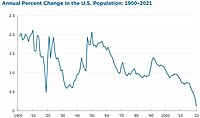
US population growth rates since 1900

U.s.a. population change and the components of change since 2000
In spite of a growing population at a national level, some formerly large American municipalities have dramatically shrunk after the Second Globe War, and in item during the 1950s–1970s, due to suburbanization, urban decay, race riots, high criminal offense rates, deindustrialization and emigration from the Rust Chugalug to the Sun Belt. For instance, Detroit'southward population peaked at almost 2 million in 1953,[85] then declined to less than 700,000 past 2020. Other cities whose populations take dramatically shrunk since the 1950s include Baltimore, Buffalo, Cincinnati, Cleveland, Flint, Gary, New Orleans, St. Louis, Pittsburgh, Scranton, Youngstown, Wilmington (Delaware). In improver, the depopulation of the Swell Plains, caused past a very loftier rate of rural flight from isolated agricultural counties, has been going on since the 1930s.
In addition, starting from the 1950s the United States take witnessed the phenomenon of the white flight or white exodus,[86] [87] [88] the big-scale migration of people of various European ancestries from racially mixed urban regions to more racially homogeneous suburban or exurban regions. The term has more recently been applied to other migrations by whites, from older, inner suburbs to rural areas, as well as from the U.S. Northeast and Midwest to the warmer climate in the Southeast and Southwest.[89] [90] [91] Migration of middle-class white populations was observed during the Civil rights movement in the 1950s and 1960s out of cities such as Cleveland, Detroit, Kansas City and Oakland, although racial segregation of public schools had ended there long earlier the Supreme Court of the U.s.a.' decision Brown v. Board of Pedagogy in 1954. In the 1970s, attempts to achieve effective desegregation (or "integration") past means of forced busing in some areas led to more families' moving out of quondam areas.[92] [93] More than recently, every bit of 2018, California had the largest indigenous/racial minority population in the United States; Non-Hispanic whites decreased from about 76.iii – 78% of the state'due south population in 1970[94] to 36.vi%% in 2018 and 39.iii% of the total population was Hispanic-Latino (of whatever race).[95]
A combination of long term trends, housing affordability, and falling birthrates and ascent expiry rates from the COVID-xix pandemic take acquired as many as 16 US states to start declining in population.[96]
France [edit]
The term 'Empty diagonal' is used for French departments that accept low or declining populations. Due to continued emigration, many departments in France are seeing declines in population, including: Aisne, Allier, Ardennes, Cantal, Charente, Cher, Corrèze, Creuse, Dordogne, Eure, Eure-et-Loir, Haute-Marne, Haute-Saône, Haute-Vienne, Hautes-Alpes, Indre, Jura, Loir-et-Cher, Lot-et-Garonne, Manche, Marne, Mayenne, Meuse, Nièvre, Orne, Sarthe, Somme, Territoire de Belfort, Vosges and Yonne. For more information, see the List of French departments by population.
South Africa [edit]
The term 'white flight' has also been used for large-scale post-colonial emigration of whites from Africa, or parts of that continent,[97] [98] [99] [100] [101] driven by levels of violent crime and anti-colonial land policies.[102] In recent decades, there has been a steady and proportional reject in South Africa's white community, due to higher birth rates among other South African ethnic groups, likewise as a high rate of emigration. In 1977, there were four.3 million White Due south Africans, constituting xvi.4% of the population at the fourth dimension. An estimated 800,000 emigrated betwixt 1995 and 2016,[103] citing crime and a lack of employment opportunities.[104]
India [edit]
The Parsis of India have one of the everyman fertility rates in the earth (0.8 children per woman in 2017); this coupled with emigration has resulted in population decline at to the lowest degree since the 1940s. Their population has more than halved from the peak.[105]
National efforts to face failing populations [edit]
A land with a declining population volition struggle to fund public services such as health care, onetime historic period benefits, defense, education, water and sewage infrastructure, etc.[106] In club to maintain some level of economical growth and continue to improve its citizens' quality of life, national efforts to face failing populations will tend to focus on the threat of a declining Gross domestic product. Because a state'due south GDP is dependent on the size and productivity of its workforce, a country confronted with a declining population, will focus on increasing the size and productivity of that workforce.
Increment the size of the workforce [edit]
A state's workforce is that segment of its working age population that is employed. Working age population is generally defined equally those people anile 15–64.[107]
Policies that could increase the size of the workforce include:
- Natalism
Natalism is a set of regime policies and cultural changes that promote parenthood and encourage women to bear more children. These more often than not fall into three broad categories:[108]
- Financial incentives. These may include child benefits and other public transfers that help families cover the cost of children.
- Back up for parents to combine family and work. This includes maternity-leave policies, parental-leave policies that grant (by constabulary) leaves of absenteeism from work to care for their children, and childcare services.
- Broad social change that encourages children and parenting
For case, Sweden built up an extensive welfare state from the 1930s and onward, partly equally a consequence of the debate following Crisis in the Population Question, published in 1934. Today, (2017) Sweden has extensive parental leave that allows parents to share 16 months paid leave per child, the toll divided between both employer and Land.[109]
Other examples include Romania's natalist policy during the 1967–90 flow and Poland's 500+ program.[110]
- Encourage more than women to join the workforce.
Encouraging those women in the working age population who are non working to observe jobs would increase the size of the workforce.[106] Female participation in the workforce currently (2018) lags men'southward in all just three countries worldwide.[111] Amidst developed countries the workforce participation gap betwixt men and women can be peculiarly wide. For example, currently (2018), in South Korea 59% of women piece of work compared with 79% of men.[111]
However, fifty-fifty assuming that more women would want to join the workforce, increasing their participation would give these countries only a short-term increase in their workforce, considering at some bespeak a participation ceiling is reached, further increases are non possible, and the impact on Gross domestic product growth ceases.
- Stop the decline of men in the workforce.
In the United States the labor force participation of men has been falling since the late 1960s.[112] The labor strength participation rate is the ratio between the size of the workforce and the size of the working historic period population. In 1969 the labor strength participation rate of men in their prime years of 25–54 was 96% and in 2015 was nether 89%.[113]
- Raise the retirement historic period.
Raising the retirement historic period has the upshot of increasing the working age population,[106] but raising the retirement historic period requires other policy and cultural changes if it is to take any impact on the size of the workforce:
- Pension reform. Many retirement policies encourage early retirement. For example, today (2018) less than ten% of Europeans between ages 64–74 are employed.[106] Instead of encouraging piece of work afterwards retirement, many public pension plans restrict earnings or hours of work.[114]
- Work identify cultural reform. Employer attitudes towards older workers must change. Extending working lives volition crave investment in preparation and working weather condition to maintain the productivity of older workers.[106]
I study estimated that increasing retirement age past two–three years per decade betwixt 2010 and 2050 would offset declining working historic period populations faced by "old" countries such as Germany and Japan.[106]
- Increment immigration.
A country tin increment the size of its workforce by importing more migrants into their working age population.[106] Even if the ethnic workforce is failing, qualified immigrants can reduce or even reverse this decline. Nonetheless, this policy tin only work if the immigrants can join the workforce and if the indigenous population accepts them.[106]
For example, starting in 2019 Nihon, a state with declining workforce, will permit 5-year visas for 250,000 un-skilled guest workers. Under the new measure, between 260,000 and 345,000 five-year visas volition be fabricated available for workers in 14 sectors suffering severe labor shortages, including caregiving, construction, agronomics and shipbuilding.[115]
- Reduce emigration.
The table in a higher place shows that long term persistent emigration, often caused by what is called "Brain Drain", is oft one of the major causes of a county's population decline. However, research has also found that emigration tin have cyberspace positive effects on sending countries, so this would debate confronting whatsoever attempts to reduce it.
Increment the productivity of the workforce [edit]
Development economists would call increasing the size of the workforce "extensive growth". They would call increasing the productivity of that workforce "intensive growth". In this example, GDP growth is driven by increased output per worker, and by extension, increased GDP/capita.[116]
In the context of a stable or declining population, increasing workforce productivity is better than more often than not curt-term efforts to increase the size of the workforce. Economic theory predicts that in the long term most growth volition exist attributable to intensive growth, that is, new technology and new and better ways of doing things plus the improver of capital letter and education to spread them to the workforce .[116]
Increasing workforce productivity through intensive growth can only succeed if workers who become unemployed through the introduction of new technology can be retrained and so that they can continue their skills current and not be left behind. Otherwise the consequence is technological unemployment.[117] Funding for worker retraining could come up from a robot tax, although the idea is controversial.[118] [119]
Long-term future trends [edit]
A long-term population refuse is typically caused past sub-replacement fertility, coupled with a net immigration rate that fails to compensate for the excess of deaths over births.[120] A long-term reject is accompanied by population aging and creates an increase in the ratio of retirees to workers and children.[120] When a sub-replacement fertility rate remains constant, population decline accelerates over the long term.[120]
Because of the global decline in the fertility charge per unit, projections of future global population show a marked slowing of population growth and the possibility of long-term refuse.[14]
The table below summarizes the Un' projections of future population growth. Any such long-term projections are necessarily highly speculative. The Un divides the globe into half-dozen regions. Nether their projections, during the period 2045–2050 Europe's population will be in decline and all other regions volition feel significant reductions in growth; furthermore, past the end of the 21st century (the menstruum 2095–2100) 3 of these regions will be showing population decline and global population growth volition exist cypher.
| Region | 2020–25 | 2045–50 | 2095–2100 |
|---|---|---|---|
| Africa | 2.37 | 1.74 | 0.61 |
| Asia | 0.77 | 0.14 | −0.39 |
| Europe | −0.05 | −0.26 | −0.14 |
| Latin America & the Caribbean | 0.84 | 0.21 | −0.46 |
| Northern America | 0.59 | 0.38 | 0.25 |
| Oceania | 1.21 | 0.80 | 0.37 |
| The World | 0.98 | 0.53 | 0.04 |
Note: the UN'due south methods for generating these numbers is explained at this reference.[121]
The table shows that the UN predicts long-term decline of population growth rates in every region; withal, short-term babe booms and healthcare improvements, among other factors, tin can cause reversals of trends. Population declines in Russia (1995–2010), Germany (1975–1985), and Republic of ireland (1850–1960) have seen long-term reversals.[ii] The Britain, having seen almost zero growth during the flow 1975–1985, is now (2015–2020) growing at 0.6% per year.[2]
See as well [edit]
References [edit]
- ^ Coleman, David; Rowthorn, Robert (January 25, 2011). "Who's Afraid of Population Decline?: A Critical Examination of Its Consequences". Population and Development Review. 37 (Suppl ane): 217–48. doi:10.1111/j.1728-4457.2011.00385.x. PMID 21280372.
- ^ a b c d e f grand h i "World Population Prospects 2019, Population Data, File: Population Growth Charge per unit, Estimates tab". United Nations Population Segmentation.
- ^ "World Population past Year". Worldometer.
- ^ Myers, Steven Lee; Wu, Jin; Fu, Claire (January 17, 2020). "Prc's Looming Crisis: A Shrinking Population". New York Times.
- ^ a b "2021 Population Data Sheet Highlights Failing Fertility Rates". International Institute of Sustainable Development. Baronial eighteen, 2021.
- ^ Craig (1994). "Replacement level fertility and future population growth". Population Trends (78): twenty–22. PMID 7834459.
- ^ "Thanks to teaching, global fertility could fall faster than expected". The Economist. 2019-02-02. ISSN 0013-0613. Retrieved 2021-04-30 .
- ^ "The impact of the COVID-19 pandemic on fertility" (PDF). Un Department of Economic and Social Affairs. Baronial 2021.
- ^ Giattino, Charlie; Ritchie, Hannah; Roser, Max; Ortiz-Ospina, Esteban; Hasell, Joe (Dec 22, 2020). "Backlog mortality during the Coronavirus pandemic (COVID-19)". Our Earth in Data.
- ^ Mark, Joshua (September 20, 2019). "Bronze Age Plummet". World History Encyclopedia.
- ^ Peterson, E. Wesley (Oct 11, 2017). "The Function of Population in Economic Growth". Sage Open. 7 (iv). doi:x.1177/2158244017736094. S2CID 158150556.
- ^ a b c d eastward Coleman, David (January 25, 2011). "Who's afraid of population decline? A disquisitional examination of its consequences". Population and Development Review. 37 (Suppl 1): 217–48. CiteSeerX10.1.i.700.5979. doi:10.1111/j.1728-4457.2011.00385.x. PMID 21280372.
- ^ Lam, David (Nov 2011). "How The World Survived the Population Bomb: Lessons From 50 Years of Boggling Demographic History". Demography. 48 (four): 1231–1262. doi:10.1007/s13524-011-0070-z. PMC3777609. PMID 22005884.
- ^ a b c "World Population Prospects 2019, Population Information, File: Population Growth Rate, Medium Variant Fertility tab". United Nations Population Sectionalization.
- ^ Vollset, Emil; Goren, Emily; Yuan, Chun-Wei (July 14, 2020). "Fertility, mortality, migration, and population scenarios for 195 countries and territories from 2017 to 2100: a forecasting analysis for the Global Burden of Disease Study". The Lancet.
- ^ Derek D. Headey; Andrew Hodge (2009). "The Effect of Population Growth on Economic Growth: A Meta-Regression Assay of the Macroeconomic Literature". Population and Development Review. 35 (2): 221–248. doi:10.1111/j.1728-4457.2009.00274.10. JSTOR 25487661.
- ^ a b "Grossly distorted motion-picture show". The Economist. xiii March 2008. Retrieved 16 September 2017.
- ^ Roser, Max (2019). "Economical Growth". Our World in Data.
- ^ Nicholas Eberstadt. 2005. "Russia, the Sick Homo of Europe". Public Interest, Wintertime 2005 "Archived copy". Archived from the original on 2008-08-07. Retrieved 2008-09-26 .
{{cite web}}: CS1 maint: archived re-create as championship (link) - ^ Florida, Richard. "The Great Growth Disconnect: Population Growth Does Not Equal Economic Growth". CityLab.
- ^ Lee, Ronald; Stonemason, Andrew; members of the NTA Network (x October 2014). "Is Low Fertility Really a Trouble? Population Aging, Dependency, and Consumption". Science. 346 (6206): 229–234. Bibcode:2014Sci...346..229L. doi:10.1126/science.1250542. PMC4545628. PMID 25301626.
- ^ http://lab.rockefeller.edu/cohenje/PDFs/226CohenHumanCacience19951.pdfJoel Due east. Cohen: Population Growth and World's Human Carrying Capacity. In: Science. 269 (1995), Southward. 341–346.
- ^ Kim, Tammy (Jan 25, 2011). "Americans Will Struggle to Abound Old at Dwelling house". Bloomberg Business concern Week.
- ^ a b Kotkin, Joel (Feb 1, 2017). "Decease Screw Demographics: The Countries Shrinking The Fastest". Forbes.
- ^ Zivkin, Yard (Sep 14, 2010). "Economical Downturns and Population Mental Health: Research Findings, Gaps, Challenges and Priorities". Psychological Medicine. 41 (7): 1343–8. doi:10.1017/S003329171000173X. PMC3846090. PMID 20836907.
- ^ Anderson, Derek (Aug iv, 2014). "Is Japan'southward Population Aging Deflationary?" (PDF). International monetary fund.
- ^ Underpopulation. Oxford Reference. Oxford Academy Press. 19 September 2013. ISBN978-0-19-959986-8.
- ^ Nichiporuk, Brian (Jan 2000). "The Evolving View of Population as a National Security Variable". Rand Corporation.
- ^ Nichiporuk, Brian (Jan 2000). "Demographics and the Changing National Security Surround". Rand Corporation.
- ^ Taub, Amanda (November 21, 2016). "'White Nationalism,' Explained". New York Times.
- ^ "FBI Monograph – State of Domestic White Nationalist Extremist Movement in the U.South." Federal Bureau of Investigation. Dec 13, 2006.
- ^ Neyer, Gerda (June iii, 2003). "Family unit Policies and Low Fertility in Western Europe" (PDF). Journal of Population and Social Security (Population).
- ^ a b Nichiporuk, Brian (2000). "The Evolving View of Population as a National Security Variable". Rand Corporation.
- ^ Smeeding, Timothy M. (October ten, 2014). "Adjusting to the fertility bust. What is the all-time response to declining populations?". Science. 346 (6206): 163–164. doi:10.1126/science.1260504. PMC6102710. PMID 25301602.
- ^ "Nihon's Population Vicious This Year, Sooner Than Expected". The New York Times. 24 December 2005.
- ^ "政府統計の総合窓口 GL08020104". world wide web.due east-stat.go.jp.
- ^ Hongo, Jun (26 Feb 2016). "Japan's Net Loss: 947,000 People". Wall Street Periodical . Retrieved 16 September 2017 – via world wide web.wsj.com.
- ^ "Statistics Bureau Home Page/Population Estimates Monthly Report". www.stat.go.jp . Retrieved 16 September 2017.
- ^ Parry, Richard Lloyd. "Japan's shrinking population suffers new record decline". The Times . Retrieved May eight, 2020.
- ^ a b c "registered through Argeweb". world wide web.geohive.com.
- ^ "Southward Korea's fertility rate falls to everyman in the world". Reuters. February 24, 2021.
- ^ "Taiwan saw 12,000 more deaths than births in first quarter of 2021". Taiwan News. ten April 2021. Retrieved 29 July 2021.
- ^ "Communism continues to cause heavy drinking in Eastern European countries". University of Kent. 18 October 2018. Retrieved 8 May 2020.
- ^ "HIV and AIDS in Eastern Europe & Cardinal Asia Overview". www.avoid.org. Avoid. 4 April 2017. Retrieved viii May 2020.
- ^ "Report: Tuberculosis still raging in Eastern Europe". Euractiv. 17 March 2015. Retrieved 8 May 2020.
- ^ "Emigration and Its Economic Impact on Eastern Europe". International Montetary Fund. Retrieved 8 May 2020.
- ^ "Armenian Statistical Service of Republic of Armenia". www.armstat.am . Retrieved xvi September 2017.
- ^ "Armenia: Regions, Districts, Cities, Towns, Villages – Population Statistics in Maps and Charts". world wide web.citypopulation.de . Retrieved 16 September 2017.
- ^ "Republic of belarus population at 9,457,500 as of 1 July 2012 - Society / News / …". Archived from the original on 2012-12-03.
- ^ a b "Estonia: Regions, Municipalities, Cities and Towns – Population Statistics in Maps and Charts". www.citypopulation.de . Retrieved 16 September 2017.
- ^ a b "Georgia: Regions, Major Cities & Urban Settlements – Population Statistics in Maps and Charts". www.citypopulation.de . Retrieved 16 September 2017.
- ^ a b "Republic of latvia: Regions, Municipalities, Cities and Towns – Population Statistics in Maps and Charts". www.citypopulation.de . Retrieved xvi September 2017.
- ^ a b "Archived copy". Archived from the original on 2011-05-25. Retrieved 2011-05-24 .
{{cite web}}: CS1 maint: archived copy every bit title (link) - ^ "Lithuania's population less than 3 meg".
- ^ "Archived copy". Archived from the original on 2010-03-24. Retrieved 2009-01-02 .
{{cite spider web}}: CS1 maint: archived copy every bit championship (link) - ^ "Archived copy". Archived from the original on 2012-08-05. Retrieved 2012-08-05 .
{{cite web}}: CS1 maint: archived copy equally championship (link) - ^ [ane] [ dead link ] Statistical Table December 2013
- ^ "Population (by judge) as of Baronial one, 2014. Average annual populations January–July 2014". ukrstat.org . Retrieved 16 September 2017.
- ^ Obrazkova, Marina (9 July 2014). "UN confirms flying of Ukrainian refugees to Russia". Retrieved 16 September 2017.
- ^ "Refugees fleeing Ukraine (since 24 February 2022)". UNHCR. 2022. Archived from the original on 10 March 2022. Retrieved 23 March 2022.
- ^ "STADAT – 1.1. Population, vital statistics (1900–)". portal.ksh.hu . Retrieved 16 September 2017.
- ^ Gulyas, Veronika (October 28, 2010). "Hungarian Population Falls Below x Meg". The Wall Street Periodical.
- ^ "Republic of albania: Prefectures, Municipalities, Municipal Units, Cities and Agglomerations – Population Statistics in Maps and Charts". www.citypopulation.de . Retrieved xvi September 2017.
- ^ "Demography 2016" (PDF). Archived from the original (PDF) on 14 Nov 2018. Retrieved 24 October 2018.
- ^ Upper-case letter.bg. "Kapital Quarterly". Retrieved 16 September 2017.
- ^ Croatian Bureau of Statistics Naselja i stanovništvo Republike Hrvatske 1857.-2001. (eng. Settlements and Population of Croatia 1857–2001) (in Croation) Archived May 5, 2012, at the Wayback Automobile, accessed 7 July 2013
- ^ Croatian Bureau of Statistics Census of Population, Households and Dwellings 2011, Get-go Results by Settlements (PDF file), accessed seven July 2013
- ^ "Population by Age and Sex activity, by Settlements, 2011 Census". Census of Population, Households and Dwellings 2011. Zagreb: Croation Bureau of Statistics. December 2012.
- ^ Croation Bureau of Statistics Notes on methodology (Demography 2011), accessed 7 July 2013
- ^ "Greek Population Has Declined by Up to Half a Million in a Decade". Greek Reporter. 2 Oct 2021. Retrieved 6 December 2021.
- ^ "Romania: Counties and Major Cities – Population Statistics in Maps and Charts". citypopulation.de . Retrieved xvi September 2017.
- ^ http://webrzs.stat.gov.rs/WebSite/userFiles/file/Aktuelnosti/Nacionalna%20pripadnost-Ethnicity.pdf[ bare URL PDF ]
- ^ "Интерактивная витрина". cbsd.gks.ru. Archived from the original on 30 January 2017. Retrieved 16 September 2017.
- ^ "How Russian federation's population changed over the years". TASS.
- ^ "Миграция в России, предварительные итоги 2021 года (Migration in Russia, preliminary results of 2021)". Институт демографии НИУ ВШЭ имени А.Г. Вишневского (Institute of Demography, National Research University A.G. Vishnevsky). 2022. Retrieved 2022-03-26 .
- ^ a b "Natural population decrease in Russia downward by 21% in Jan 2022 vs Jan 2021, but twice higher than in January 2020 - Rosstat". Interfax News Bureau. six March 2022. Retrieved 2022-03-26 .
- ^ "Kingdom of spain'due south population cruel in 2020, catastrophe four-twelvemonth growth streak". Reuters. April 20, 2021. Retrieved 29 July 2021.
- ^ Salzano, Giovanni (March 26, 2021). "Italy's Population Fell the Most in Over 100 Years in 2020". Bloomberg . Retrieved 29 July 2021.
- ^ "Resident population (No.) by Place of residence, Sex activity and Age group". Instituto Nacional de Estatística. Retrieved 2022-03-24 .
- ^ "Brazilians flock into Portugal for the fourth straight year". mercopress.com. eighteen Jun 2021. Retrieved 2022-03-24 .
- ^ "Demography Population (Federal republic of germany): Federal States, Cities and Communes – Population Statistics, Charts and Map". www.citypopulation.de . Retrieved 16 September 2017.
- ^ "Immigration additional German language population in 2012". Archived from the original on 2013-01-fifteen.
- ^ File:Population of German territories 1800 - 2000.JPG
- ^ "Population and Migration Estimates April 2019 - CSO - Cardinal Statistics Office".
- ^ Jacobs, Andrew James (2013). The world's cities : contrasting regional, national, and global perspectives (1st ed.). New York: Routledge. p. 355. ISBN9780415894852.
- ^ Barry C. Feld; Donna M. Bishop, eds. (2013). The Oxford Handbook of Juvenile Law-breaking and Juvenile Justice. Oxford Academy Press. ISBN978-0199338276.
The Kerner Commission report ... ended that "Our nation is moving toward two societies, one black, i white" ... Blackness urban in-migration and White exodus had developed concentrations of impoverished persons.
- ^ Robert W. Kweit (2015). People and Politics in Urban America, Second Edition. Routledge. ISBN978-1138012028.
The U.S. courtroom of Appeals ruled that Norfolk was rightly concerned with the white exodus from public schools and that the decision to terminate mandatory busing was not based on discriminatory intent, but on the desire to keep enough whites in the school organization to prevent resegregation.
- ^ Timothy J. Minchin; John A. Salmond (2011). "Affiliate 8 'Mixed Outcomes'". After the Dream: Blackness and White Southerners since 1965 (Ceremonious Rights and Struggle). University Press of Kentucky. ISBN978-0813129785.
Even success in desegregating downtown stores and buses was now undercut by the white exodus. As they fled the cities, many whites lost interest in the civil rights outcome.
- ^ Schaefer, Richard T., ed. (2008). The Encyclopedia of Race, Ethnicity, and Society. SAGE publications.
- ^ "white flight". Merriam-Webster Lexicon.
- ^ Armor, David J. (1986). Forced Justice: School Desegregation and the Law. Oxford University Press US. ISBN978-0-1953-58179.
- ^ Clotfelter, Charles T. (2004). Afterwards Brown: The Rise and Retreat of School Desegregation . Princeton Academy Press. ISBN9780691119113.
- ^ Ravitch, Diane (1983). The Troubled Crusade: American Teaching, 1945–1980 . New York City: Basic books. p. 177. ISBN978-0-4650-87570.
Schoolhouse desegregation and White Flying..
- ^ "Historical Census Statistics on Population Totals By Race, California". Census.gov . Retrieved October 7, 2017.
- ^ "B03002 HISPANIC OR LATINO ORIGIN BY RACE – California – 2018 American Community Survey 1-Year Estimates". U.S. Census Bureau. July 1, 2018. Retrieved November 25, 2019.
- ^ "Demography Estimates Evidence Population Turn down in 16 States". pew.org . Retrieved 2021-07-04 .
- ^ Joshua Hammer (May–June 2010). "(Almost) Out of Africa: The White Tribes". Earth Affairs Journal. Archived from the original on 2016-03-30. Retrieved 2020-05-08 .
{{cite news}}: CS1 maint: unfit URL (link) - ^ Johnson, RW (October 19, 2008). "Mosiuoa 'Terror' Lekota threatens to topple the ANC". The Times. London.
- ^ Christopher, A.J. (2000). The atlas of changing Southward Africa (2d ed.). Routledge. p. 213. ISBN978-0-2031-85902.
- ^ Bradshaw, York West.; Ndegwa, Stephen N., eds. (2001). The uncertain promise of Southern Africa. Indiana Univ. Printing. p. 6.
- ^ Reinhardt, Steven One thousand.; Reinhartz, Dennis P., eds. (2006). Transatlantic history (1st ed.). Texas A&M University Press. pp. 149–150. ISBN978-1-5854-44861.
- ^ "White flight from South Africa: Between staying and going". The Economist. September 25, 2008.
- ^ White flying from S Africa | Between staying and going Archived 12 August 2016 at the Wayback Car, The Economist, 25 September 2008
- ^ Peet van Aardt (24 September 2006). "Million whites get out SA – written report". 24.com. Archived from the original on xvi April 2008. Retrieved 5 June 2013.
- ^ Dore, Bhavya (21 July 2017). "Glimmer of hope at last for India's vanishing Parsis". BBC.
- ^ a b c d due east f g h "Many countries endure from shrinking working-age populations". The Economist. May 5, 2018.
- ^ "Working age population". OECD (System for Economical Cooperation and Development). 2020.
- ^ Straughan, Paulin Tay (2008). "Very low fertility in Pacific Asian Countries: Causes and policy responses". Singapore Management University. p. viii.
- ^ Crisp, James (December 20, 2017). "Take five months parental exit, Swedish fathers told". The Telegraph. Archived from the original on 2022-01-12.
- ^ "Prime Minister Mateusz Morawiecki: The "500+" Programme is an investment in Poland's future". premier.gov.pl. March 19, 2019.
- ^ a b "Many countries suffer from shrinking working-age populations". The Economist. May 5, 2018.
- ^ Rothstein, Donna (August 2019). "Men who practise not work during their prime years: What practice the National Longitudinal Surveys of Youth information reveal?". U.South. Bureau of Labor Statistics.
- ^ Rothstein, Donna (August 2019). "Men who do non piece of work during their prime years: What do the National Longitudinal Surveys of Youth data reveal?". U.S. Bureau of Labor Statistics.
- ^ Fitzpatrick, Maria D. (November 2018). "Pension Reform and Return to Work Policies". The National Agency of Economic Research. doi:x.3386/w25299. S2CID 239843977.
- ^ Rich, Motoko (December 7, 2018). "Bucking a Global Tendency, Japan Seeks More Immigrants. Ambivalently". The New York Times.
- ^ a b "Has the ideas auto broken down?". The Economist. January 12, 2013.
- ^ Brynjolfsson, Erik; McAfee, Andrew (2011). Race Against The Machine: How the Digital Revolution is Accelerating Innovation, Driving Productivity, and Irreversibly Transforming Employment and the Economy. Digital Frontier Press.
- ^ Rubin, Richard (Jan 8, 2020). "The "Robot Tax" Debate Heats Upwards". The Wall Street Journal.
- ^ Delaney, Kevin (February 17, 2017). "The robot that takes your job should pay taxes, says Bill Gates". QUARTZ.
- ^ a b c Bonin, Holger (2001). Generational bookkeeping: theory and application. Springer. ISBN978-3-540-42266-2.
- ^ "World Population Prospects 2019, Methodology of the United Nations population estimates and projections" (PDF). United nations Department of Economic and Social Affairs. 2019.
Further reading [edit]
- "Human population numbers every bit a function of food supply" (PDF). Russell Hopfenberg (1 Duke Academy, Durham, NC, United states of america;)* and David Pimentel (2 Cornell Academy, Ithaca, NY, Usa). Environs, development and sustainability 3.1: 1-xv.
abdullahtinur1952.blogspot.com
Source: https://en.wikipedia.org/wiki/Population_decline

Post a Comment for "Aside From Low Birthrates and High Death Rates, What Can Cause a Countrys Population to Decline?"